Thursday, June 18, 2009
S&P Cuts Credit Ratings on 22 Banks
On a day when many banks announced they are paying back their TARP loans, Standard & Poor’s credit analysts cut the credit ratings or revised the outlooks on 22 national and regional banks Wednesday.
The firms on S&P’s list included such large names as Wells Fargo & Co. (WFC), U.S. Bancorp (USB), PNC Financial (PNC), BB&T Corp (BBT) and KeyCorp (KEY).
S&P, the largest of the three major credit agencies, said it was revising the credit ratings of these banks in light that “operating conditions for the industry will become less favorable than they were in the past.”
Several smaller regional banks were also cut to “junk” status as part of S&P’s broad revisions. The banks pushed into junk territory are Carolina First Bank, Citizens Republic Bancorp Inc. (CBRC), Huntington Bancshares Inc. (HBAN), Synovus Financial Corp. (SNV) and Whitney Holding Corp. (WTNY).FullStory


Gold Going vending
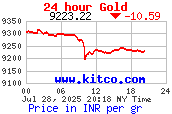
TG-Gold-Super-Markt aims to introduce the machines at 500 locations including train stations and airports in Germany.The company, based near Stuttgart, hopes to tap into the increasing interest in buying gold following disillusionment in other investments due to the economic downturn.
Gold prices from the machines – about 30 per cent higher than market prices for the cheapest product – will be updated every few minutes. Customers using a prototype "Gold to go" machine at Frankfurt Airport on Tuesday had the choice of purchasing a 1g wafer of gold for €30, a 10g bar for €245, or gold coins. A camera on the machine monitors transactions for money laundering controls.
Thomas Geissler, who owns the company behind the idea, said: "German investors have always preferred to hold a lot of personal wealth in gold, for historical reasons. They have twice lost everything. Full Story
Gold prices from the machines – about 30 per cent higher than market prices for the cheapest product – will be updated every few minutes. Customers using a prototype "Gold to go" machine at Frankfurt Airport on Tuesday had the choice of purchasing a 1g wafer of gold for €30, a 10g bar for €245, or gold coins. A camera on the machine monitors transactions for money laundering controls.
Thomas Geissler, who owns the company behind the idea, said: "German investors have always preferred to hold a lot of personal wealth in gold, for historical reasons. They have twice lost everything. Full Story
The biggest bill in history
THE worst global economic storm since the 1930s may be beginning to clear, but another cloud already looms on the financial horizon: massive public debt. Across the rich world governments are borrowing vast amounts as the recession reduces tax revenue and spending mounts—on bail-outs, unemployment benefits and stimulus plans. New figures from economists at the IMF suggest that the public debt of the ten leading rich countries will rise from 78% of GDP in 2007 to 114% by 2014. These governments will then owe around $50,000 for every one of their citizens (see article).
Not since the second world war have so many governments borrowed so much so quickly or, collectively, been so heavily in hock. And today’s debt surge, unlike the wartime one, will not be temporary. Even after the recession ends few rich countries will be running budgets tight enough to stop their debt from rising further. Worse, today’s borrowing binge is taking place just before a slow-motion budget-bust caused by the pension and health-care costs of a greying population. By 2050 a third of the rich world’s population will be over 60. The demographic bill is likely to be ten times bigger than the fiscal cost of the financial crisis.Full Story
Subscribe to:
Posts (Atom)